01 — The molecule
Mebufotenin is the unusual one.
Most classical psychedelics are driven first by the 5-HT2A receptor. 5-MeO-DMT leads with 5-HT1A — and that difference is the whole reason it is interesting for mood.
5-Methoxy-N,N-dimethyltryptamine — mebufotenin — is a naturally occurring tryptamine found in Anadenanthera seeds and the secretion of the Sonoran Desert toad. Pharmacologically it is a serotonin-receptor agonist, but with an affinity split that sets it apart from psilocin or DMT: it binds the 5-HT1A subtype with very high affinity (Ki in the low-nanomolar range) and the 5-HT2A subtype an order of magnitude or more weaker.
In broad terms, 5-HT1A engagement is associated with the anxiolytic and antidepressant arm of serotonergic signalling, while 5-HT2A engagement drives the classic perceptual, "psychedelic" arm. A 1A-leading tryptamine therefore has a distinctive character: profound but compressed, and — critically for a medicine — short.
It is also metabolically fast. 5-MeO-DMT is eliminated rapidly, in part via CYP2D6 to bufotenine (5-HO-DMT) and via monoamine oxidase-A. That fast clearance is why the free base, vaporised, has a half-life measured in minutes — and why the entire experience can begin and resolve inside an hour.
Bars schematic; 1A-preferring profile per Reckweg et al. 2022; Ki thresholds (5-HT1A below 10 nM, 5-HT2A above 1,000 nM) per Ragnhildstveit et al. 2023.
CYP2D6 shapes the person, not just the dose
Because a meaningful fraction is converted to bufotenine by CYP2D6, an individual's metaboliser status can quietly reshape exposure. A delivery route that front-loads a clean, reproducible plasma peak is one way to reduce that variability — a formulation lever, not a chemistry one.
02 — Why the salt and the powder matter
A tryptamine is only as good as the way it arrives.
The pharmacology has been known for decades. What changed recently is delivery: turning a fast, fragile base into a stable intranasal solid that lands a clean peak in minutes. That is a formulation problem — and it is where this investigation lives.
Benzoate over hydrochloride
Liquid intranasal hydrochloride formulations of 5-MeO-DMT are dogged by stability and discolouration problems. Moving to the benzoate salt — the counterion at the heart of BPL-003 — yields a solid with better handling and a cleaner pharmacokinetic profile.
Spray-dried powder
Rather than a spray solution, the drug is a spray-dried intranasal powder carrying mucoadhesive polymers (HPMC blends, chitosan, carbomers). The powder resists run-off, holds the dose against the mucosa, and survives storage.
Mucoadhesion buys time
The nasal cavity clears foreign material in minutes. Mucoadhesive excipients extend residence so more drug crosses before clearance — raising bioavailability and sharpening the peak that the 5-HT1A arm depends on.
Figures describe the published intranasal 5-MeO-DMT benzoate profile (Phase 1 SAD; Phase 2 open-label discharge-readiness median; formulation literature). Not a dosing recommendation.
03 — The investigation
What Panacea Bio Chem is testing.
Panacea Bio Chem's core competence is not the pharmacology of the molecule — it is the solid-state and delivery science around it: salt selection, lyophilisation, amorphous stability, and the way a dried dose behaves on a mucosal surface. Those are exactly the levers that decide whether a fast tryptamine becomes a reproducible medicine.
The four items below are working hypotheses and bench observations from that programme — research positions, deliberately framed as questions under test. They are not clinical claims, and none of them is a statement about treating any person.
The benzoate does more than balance a charge.
The shift from hydrochloride to benzoate is usually explained by stability. Our bench view is that the benzoate also changes crystal habit and surface energy in a way that improves powder flow and dissolution kinetics at the mucosa — meaning part of BPL-003's clean, early peak may be a solid-state effect, not only a chemical-stability one. We are characterising crystalline vs amorphous fractions of the benzoate to separate the two.
Basis: HCl-liquid instability/discolouration is documented; benzoate-salt and powder-formulation patents describe improved PK. The crystal-habit contribution is our hypothesis under test.
A freeze-dried route to a more uniform peak.
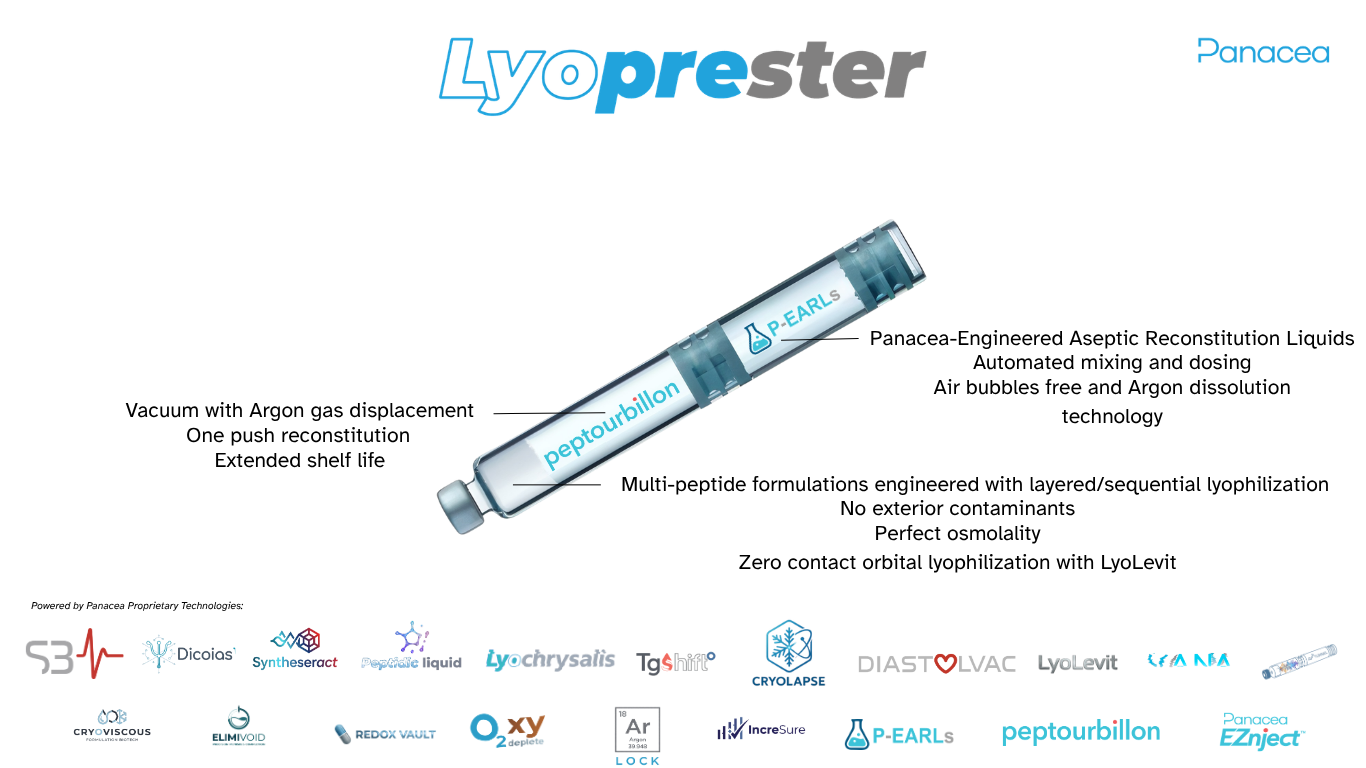
Spray drying is one way to a dry powder; lyophilisation is another, and it is Panacea's home ground. We are investigating whether a lyophilised amorphous solid dispersion of mebufotenin benzoate — the kind of glassy, moisture-locked cake our Lyoprester platform is built to make — can hold the drug in a faster-dissolving state with a longer shelf life than a spray-dried crystalline powder, tightening dose-to-dose reproducibility of the plasma peak.
Basis: lyophilised amorphous dispersions are an established solubility/stability strategy; applying them to a tryptamine benzoate for nasal delivery is our line of work.
Shaping the door, not just opening it.
Because subjective onset tracks the plasma rise, the mucoadhesive polymer blend is effectively a tuning knob on the shape of the experience — how steep the climb, how compact the peak. We are mapping polymer viscosity and mucoadhesion against the rise-time of exposure, asking whether a formulation can be tuned toward the compressed 8-to-15-minute peak that a supervised, single-session model wants — without extending the tail.
Basis: mucoadhesive nasal systems demonstrably raise residence and bioavailability (thermosensitive gel and powder literature). Onset-shaping via polymer choice is our applied hypothesis.
Designing around CYP2D6, from the powder up.
CYP2D6 variability turns a fixed dose into a variable exposure. Rather than treat that as a clinical-dosing problem, we are asking whether a delivery system that produces a sharper, more front-loaded absorption profile can reduce the window in which first-pass and enzymatic conversion act — narrowing the spread between fast and slow metabolisers at the level of the formulation.
Basis: CYP2D6-dependent conversion to bufotenine is documented; formulation-led exposure control is a recognised strategy and our specific hypothesis here.
How to read the word "discovered"
On this site, a discovery means a reproducible bench observation or a testable hypothesis from a formulation programme — the honest currency of early research. It does not mean a clinical finding, an established treatment, or approval by any regulator. Where the field has hard clinical data, we cite it as the field's; where a claim is ours, we mark it as a hypothesis under test.
04 — From nasal to depot
The long-acting injectable programme.
Initiated spring 2023: taking mebufotenin off the mucosa and into a biodegradable depot — trading the acute intranasal peak for a delayed-onset, sustained sub-perceptual release profile measured in weeks rather than minutes.
The therapeutic rationale is a decoupling. The intranasal route ties the antidepressant 5-HT1A arm to a sharp, supervised 5-HT2A psychedelic peak. A long-acting injectable (LAI) depot proposes the opposite geometry: hold plasma exposure below the perceptual threshold and keep it there, so the tonic 5-HT1A signalling associated with mood is engaged continuously — the pharmacokinetic equivalent of a sustained, non-psychedelic microdose — without the repeated acute peaks that drive the trip. This is a formulation programme and a lead hypothesis, not a clinical result.
Lipid nanoparticles inside a polyester depot
Mebufotenin benzoate is first encapsulated in solid lipid nanoparticles (SLN / nanostructured lipid carriers), then those nanoparticles are dispersed within biodegradable PLGA microspheres — a nano-in-micro construction. The lipid phase shields the labile tryptamine and raises encapsulation efficiency; the poly(lactic-co-glycolic acid) matrix sets the release clock.
Suppress the burst, engineer the lag
Naked PLGA depots release triphasically — an initial burst, a diffusion phase, then erosion-controlled release. For a potent tryptamine, that burst is the enemy. The lipid encapsulation and a tuned lactide:glycolide ratio are used to flatten the burst and program a lag phase — delayed onset, then a near-zero-order plateau governed by polymer hydrolysis.
Sub-perceptual by design
The depot target sits under the psychoactive threshold on purpose. It is not a four-week experience; it is a four-week exposure — steady, low, tonic 5-HT1A engagement, with the acute perceptual peak deliberately absent. A different therapeutic object from the single supervised dose, aimed at a different clinical setting.
Depot release — illustrative delayed, sustained profile
Delayed onset · zero-order-like plateauSingle depot
Illustrative design target, not measured data. Contrast with the minutes-scale intranasal envelope at the top of this page.
One depot, weeks of tonic exposure.
The programme's stated design target is a single sub-milligram depot — on the order of a few hundred micrograms of encapsulated mebufotenin benzoate — engineered for a delayed onset and a sustained, sub-perceptual release across roughly four weeks from one intramuscular or subcutaneous injection. This is the target the formulation is being built and characterised against; it is a preclinical objective and a hypothesis under test, not a demonstrated clinical outcome.
Basis: PLGA and lipid depot systems routinely deliver weeks-to-months of sustained release for other actives (leuprolide, risperidone LAI, exenatide). Applying a nano-in-micro delayed-release architecture to a sub-perceptual tryptamine exposure is the novel, and unproven, element.
What is claimed here — and what is not
Claimed: an active formulation-research programme, a defined delivery architecture, and a design target. Not claimed: any human efficacy result, safety finding, dose recommendation, or regulatory status. No person should infer a treatment from this section. 5-MeO-DMT is a controlled substance and an investigational drug; a long-acting depot of any psychoactive is a preclinical research concept here, nothing more.
05 — The clinical field (not ours)
Where the medicine actually stands.
To keep the science honest, here is the real clinical state of intranasal 5-MeO-DMT benzoate — the work of Beckley Psytech and atai (now AtaiBeckley), reported publicly and attributed to them, not to us.
Single ascending dose established the profile
A placebo-controlled single-ascending-dose study characterised intranasal BPL-003 (mebufotenin benzoate): rapid absorption, a plasma peak at a median of roughly eight to ten minutes, a terminal half-life under about half an hour, and dose-related intensity of altered states — the pharmacokinetic backbone the whole programme rests on (Rucker et al., 2024).
A single dose, a dose-finding read-out
An eight-week, quadruple-masked, dose-finding core stage enrolled 193 patients with moderate-to-severe TRD across 38 sites in 6 countries. A single 8 mg dose produced a mean MADRS reduction of about 12 points at day 29 versus roughly 6 in the low-dose comparator; the study met its primary and key secondary endpoints (atai / Beckley Psytech topline, 2025).
Short, supervised, mostly mild
Over 99% of treatment-emergent adverse events were mild or moderate, with no drug-related serious adverse events reported; the 8 mg dose was better tolerated than 12 mg. The developer indicated it would advance the 8 mg dose, subject to regulatory discussion.
Rapid-acting, scalable, single-session
The appeal is structural: an antidepressant effect after one supervised dose, with a median time to discharge readiness of 98 minutes (range 95–167) in the open-label Phase 2 study — a model built for outpatient scale rather than weeks of daily dosing. Positive results reportedly contributed to the atai–Beckley combination.
All Phase 1/2b figures above are the sponsors' publicly reported results and belong to them. Panacea Bio Chem is an independent formulation-science investigator and is not affiliated with, nor speaking for, Beckley Psytech or atai.
06 — In the investigator's words

"The active molecule is rarely the bottleneck — the delivered, stable solid is. Here that discipline meets the most time-compressed molecule in the field, where every second of the absorption curve is doing therapeutic work. The question was never whether mebufotenin does something; the field has answered that. It is whether the delivery can be made reproducible, stable and clean enough to be a real medicine. That is a formulation question — and it is the one being tested here."
— Bogdan Dicoias, Panacea Bio Chem
07 — Enquiries
Collaboration & correspondence
Formulation and solid-state collaboration, analytical partnership, and scientific correspondence are welcome. This is a research site, not a clinic and not a supplier.
Boundaries, stated plainly
5-MeO-DMT is a controlled substance in most jurisdictions and an investigational drug in the clinic. Nothing here is medical advice, a dosing guide, a synthesis route, or an offer to supply. No claim of safety, efficacy, or regulatory approval is made for any Panacea Bio Chem work described on this page.
Clinical results shown belong to their sponsors and are cited as theirs. Everything attributed to Panacea Bio Chem is early-stage formulation research or an explicitly labelled hypothesis under test.
08 — Sources
References & further reading
- Reckweg JT, et al. The clinical pharmacology and potential therapeutic applications of 5-MeO-DMT. J Neurochem, 2022. wiley
- Rucker J, et al. Phase 1 single-ascending-dose trial of intranasal BPL-003 (5-MeO-DMT benzoate) in healthy participants. J Psychopharmacol, 2024. pubmed
- Roberts C, et al. A phase 2 uncontrolled, open-label study of intranasal BPL-003 (5-methoxy-N,N-dimethyltryptamine) in patients with treatment-resistant depression. J Psychopharmacol, 2026. pubmed
- atai Life Sciences & Beckley Psytech — Phase 2b BPL-003 TRD topline results, 2025. atai IR
- Beckley's 5-MeO-DMT shows rapid, durable antidepressant effects in Phase 2b. Psychedelic Alpha, 2025. psychedelicalpha
- Ermakova AO, et al. Mapping the phenomenology of intranasal 5-MeO-DMT in psychedelic-naïve healthy adults. Sci Rep, 2025. nature
- Kargbo RB. Optimized Parenteral and Intranasal Formulations of Tryptamine Psychedelics for Rapid-Acting Antidepressant Therapy. ACS Med Chem Lett, 2025. acs
- Benzoate salt of 5-MeO-DMT — patent WO2023111544A2. patents
- 5-MeO-DMT powder formulations — patent WO2025153822A1. patents
- Miranda P, et al. Novel Thermosensitive and Mucoadhesive Nasal Hydrogel Containing 5-MeO-DMT Optimized Using Box-Behnken Experimental Design. Polymers, 2024. pmc
- Ragnhildstveit A, et al. 5-MeO-DMT for post-traumatic stress disorder: a real-world longitudinal case study. Front Psychiatry, 2023. pubmed
09 — Questions
Frequently asked questions
What is 5-MDMT?
A founder-led delivery-science investigation by Panacea Bio Chem into mebufotenin (5-MeO-DMT) — specifically the benzoate salt form, spray-dried and lyophilised powders, and mucoadhesive intranasal delivery behind rapid-onset tryptamine research such as the BPL-003 programme.
Is Panacea Bio Chem affiliated with Beckley Psytech or atai?
No. Panacea Bio Chem is an independent formulation-science investigator. The clinical results shown on this site belong to their sponsors (Beckley Psytech / atai) and are cited as theirs, publicly reported.
What is Panacea Bio Chem actually testing?
Four working hypotheses around the solid state: the benzoate counterion's effect on crystal habit, a lyophilised amorphous dispersion route, mucoadhesive residence-time tuning, and formulation-led reduction of CYP2D6-driven exposure variability — plus a preclinical long-acting depot design target.
Does this site supply 5-MeO-DMT or give dosing guidance?
No. 5-MeO-DMT is a controlled substance in most jurisdictions and an investigational drug. This is a research site: nothing here is medical advice, a dosing guide, a synthesis route, or an offer to supply.
Who runs the 5-MDMT investigation?
Panacea Bio Chem Ltd, the formulation-science company of Bogdan Dicoias — the house behind the LyoLevit levitated lyophilisation platform and the peptide-preservation line.
10 — Trending in the field
Trending in the field
Recent developments in the field — refreshed 2026-10-15 by Panacea Bio Chem.
- Pharmacological, clinical, and translational evidence for N,N-dimethyltryptamine, 5-methoxy-N,N-dimethyltryptamine, and zalsupindole: a systematic review — PubMed, 2026 Oct 6
- The impact of behavioural activity on the EEG power spectrum, its source localisation, and global functional connectivity in rats — PubMed, 2026 Oct 2
- Adverse Health Outcomes of Psilocybin, LSD, MDMA, Ibogaine, and 5-MeO-DMT — PubMed, 2026 Sep 1
- Characterizing Psychedelic-Evoked Familiarity: A Comparative Study with Autobiographical and Déjà Vu Experiences — PubMed, 2026 Sep 11